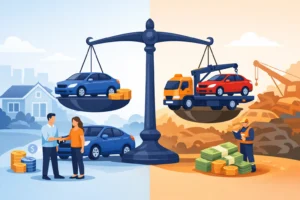
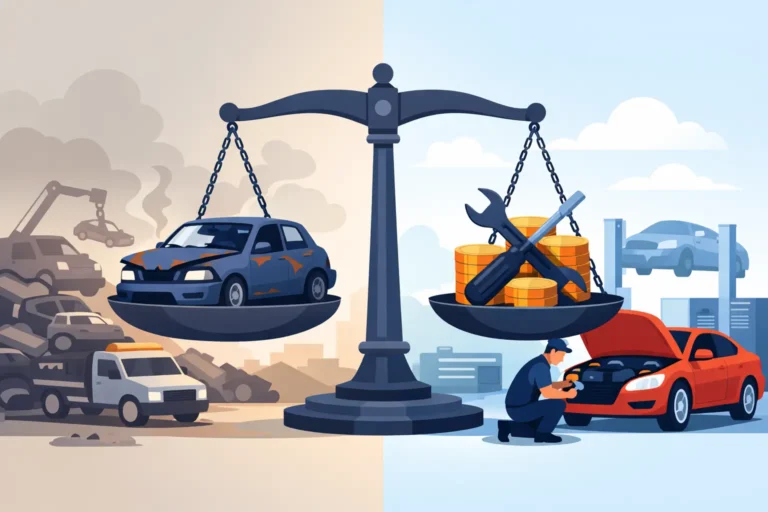
A failed transmission, blown head gasket, or crash-damaged front end can turn a normal car decision into an expensive one fast. Scrap car versus repair comes down to one practical question: will spending more money get you a reliable vehicle that is worth keeping, or are you paying to delay the inevitable?
For many owners, the answer is not simply based on the repair quote. The age of the vehicle, its condition, its safety, how long you need it to last, and what it could sell for afterward all matter. A cheap repair can make sense. A major repair on a tired vehicle with several other problems usually does not.
Scrap Car Versus Repair Starts With the Numbers
Get a written estimate for the immediate repair, then look beyond that one job. If your car needs a $1,200 alternator repair but is otherwise dependable, repairing it may be the sensible move. If it needs a $3,500 engine replacement, worn tires, suspension work, brake repairs, and registration renewal, the real cost is much higher than the first quote.
A useful rule is to compare the repair cost with the vehicle’s current market value in running condition. When a single repair is close to or greater than half that value, it is time to seriously consider selling the vehicle as-is. This is not an absolute rule. A well-maintained car you know well may still be worth fixing, while an older car with a long list of faults may not be worth repairing even at a lower cost.
Also ask the mechanic what caused the failure. Replacing a battery is routine. Replacing an engine because of overheating can be different. The original overheating issue may have damaged other components, and the final bill can grow after work begins.
Do Not Let Sunk Costs Make the Decision
It is easy to think, “I have already spent too much on this car to give up now.” That money is gone whether you repair the vehicle or not. The better question is what you will need to spend from this point forward.
Think about the last 12 months. Have you paid for repeated breakdowns, oil leaks, cooling problems, electrical faults, or failed inspections? Has the car been off the road more than it has been useful? Those are signs that another major repair may not restore dependable transport.
A repair that gets the vehicle moving again is not always a repair that makes it reliable. If you need a car every day for work, school runs, deliveries, or appointments, another breakdown has a cost beyond the workshop invoice. Lost time, towing, missed work, and arranging another ride can add up quickly.
When Repairing Your Car Makes Good Sense
Repair is often the right choice when the fault is isolated and the rest of the vehicle is in good shape. A newer vehicle with a clean service record, solid body, safe tires and brakes, and no warning signs may have years of useful life left after a proper repair.
It can also make sense when replacing the car would cost far more than the repair. Spending $900 on a dependable vehicle can be better than taking on a much larger payment or buying another used car with unknown issues.
Before approving the work, ask for a clear breakdown of parts, labor, taxes, and any likely additional repairs. Find out whether new, rebuilt, or recycled parts are being used and whether the work is covered by a warranty. A good quote helps you make a decision with facts instead of pressure.
There is another option worth considering for common makes: quality used auto parts. A recycled door, mirror, gearbox, engine component, or interior part can lower the cost of a sensible repair. This works best when the vehicle itself is still worth keeping and the replacement part addresses a specific problem.
Signs It Is Time to Scrap or Sell As-Is
Some vehicles are no longer economical to repair, even if they still start and drive. Severe accident damage, major rust, flood damage, engine failure, transmission failure, and repeated electrical issues can make a car a money pit.
Deregistered and non-running vehicles are also difficult to sell privately. A buyer may need to arrange towing, inspect the damage, source parts, and take on the risk of hidden faults. That usually means long delays, no-shows, and low offers from people who expect you to handle the hard part.
Selling for scrap or to a vehicle buyer is often the cleaner choice if the car has any of these problems:
- The repair estimate is higher than the car’s likely running value.
- It has multiple major faults, not one clear repair.
- The vehicle is unsafe, badly damaged, or has structural rust.
- It has been sitting in a driveway, garage, or yard for months.
- You cannot justify paying for towing, repairs, registration, and future maintenance.
A damaged vehicle still has value. Its metal, catalytic converter, wheels, panels, engine parts, transmission, and other reusable components may be worth money. The amount depends on the make, model, age, weight, condition, demand for parts, and whether the vehicle can be collected easily.
Factor in the Cost and Hassle of Selling Privately
A private sale can bring more money for a good running car. It is usually not the best route for a dead, damaged, or scrap vehicle. You may need to pay for a tow, take photos, answer messages, wait for buyers, and deal with people who negotiate after arriving.
Be honest about your car’s condition if you choose to advertise it. State whether it runs, whether it is registered, what damage it has, and what repairs are needed. Hiding serious faults can waste everyone’s time and create problems after the sale.
For an unwanted vehicle that cannot be driven, a direct buyer removes most of that work. Quick Cash For Cars buys cars, vans, utes, 4WDs, trucks, buses, and heavy machinery in a wide range of conditions. The process is built for owners who need the vehicle gone, not owners who want to spend weeks trying to find the right private buyer.
Get a Fair Scrap Car Quote
A quote should reflect more than the fact that your car is old or non-running. When requesting one, provide the make, model, year, location, overall condition, and a simple description of the damage. Mention whether it starts, whether major parts are missing, and whether the vehicle has been deregistered.
Clear details lead to a more accurate offer. They also help the buyer arrange the right collection vehicle, especially for vans, trucks, machinery, or cars that cannot roll.
Ask whether towing is included and whether there are any collection or paperwork fees. Free removal matters because paying to move a dead vehicle can quickly reduce what you take home. Confirm how and when payment is made before collection, so there are no surprises at pickup.
A Simple Way to Make the Call
First, get a proper repair estimate and ask what other work is likely soon. Second, check what similar running vehicles are actually worth, not just the highest advertised prices. Third, request an as-is purchase or scrap quote that includes removal.
Put those numbers side by side. If the repair is reasonable and gives you a safe, dependable car, fix it. If the costs are climbing, the vehicle has several faults, or you simply need it removed without another bill, selling it as-is can be the smarter financial move.
Your driveway does not need to become storage for a car that has already taken enough time and money. Choose the option that gives you dependable transport or gets cash in hand and the unwanted vehicle out of the way.